Walking Brisbane’s Boundary Streets
A Learning Companion to Aunty Heather Castledine’s Session · Sunday 6 December 2026
Cultural Advice and Content Warning
Aboriginal and Torres Strait Islander readers are advised that this learning companion and the works to which it links name people who have died, show their images, and describe curfews, police violence, and frontier war. 13YARN, the national First Nations crisis support line, answers on 13 92 76, day and night.
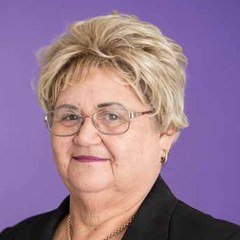
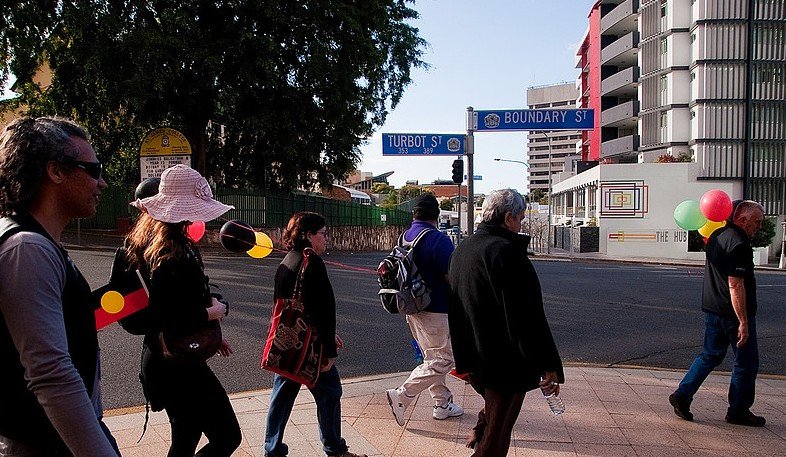
Aunty Heather Castledine, a Kamilaroi-Kooma Elder, was born in St George and grew up in a country town segregated by race. She worked twenty-seven years in the outback, qualified as a social worker, and made Logan her home. In 2009 she began the Boundary Street to Boundary Street walk, along the line that Brisbane once forbade Aboriginal people to cross after four each afternoon and all day Sunday. For many years she served as Aboriginal Co-Chair of Reconciliation Queensland.
What is a learning companion?
A thematic set of ingredients to read, watch, hear, and explore, chosen to accompany a Truth-Telling session. Start with twenty minutes below, before the session or after it, then follow the four threads over the weeks ahead.
About Learning Companions
Start here · Twenty minutes
Hear Aunty Heather on Radio 4EB
Aunty Heather Castledine on Women’s Profile, Radio 4EB Brisbane, 9 August 2019. Recording published by Reconciliation Queensland.
On the day before the 2019 walk, Aunty Heather sat down at Radio 4EB. In nineteen minutes she speaks of the curfew that the two Boundary Streets record, of the walk across the city, and of the Elder who told her it was time to put something back into her community.
Then read the National Indigenous Times on the streets themselves. In its report the Elder Sam Watson says why the name Boundary Street should stay.
Listen for the dates. The curfew began in the 1850s. Aunty Heather’s own aunties and uncles met it a century later.
Consider thisHow does a city keep a street name and lose the reason for it?
Four Ways to Keep Exploring
Each selection opens a different side of Aunty Heather’s story: the boundary in a novelist’s hands, the colour bar in country towns, the war for the river country where she was born, and the written record of the curfew. Begin with whichever draws you, and return to the others when a question sends you looking.
01 · Read · Novel
The Boundary
Nicole Watson · UQP, 2011; First Nations Classics edition, 2026 · A crime novel for the coming weeks
A judge rejects the Corrowa People’s native title claim over Meston Park, in Brisbane’s West End, and dies in his home hours later. The lawyers who opposed the claim die next. Nicole Watson, a Mununjali and Birri Gubba woman and a legal scholar, sets her murder mystery on the old boundary that barred Aboriginal people from the city at night. The novel won the David Unaipon Award in 2009.
The connection. Watson is the daughter of the Elder Sam Watson, who argued for keeping the name Boundary Street so that nobody could conceal its history. Her novel asks what the old line still decides in Brisbane today.
As you readWho in the novel knows what the boundary meant, and who has never been told?
Borrow or buy the book. For a life lived across these lines, read Auntie Rita, by Rita Huggins and Jackie Huggins (Aboriginal Studies Press, revised edition 2023): the memoir of a Bidjara woman removed to Cherbourg as a girl, who later worked for her people in Brisbane.
02 · Watch · Free on YouTube
Living Black: Freedom Rides
Presented by Karla Grant · NITV, 2015 · 26 minutes
In February 1965 Charles Perkins led a busload of University of Sydney students through the country towns of New South Wales. At Walgett they picketed the RSL club that refused Aboriginal ex-servicemen. At Moree they challenged the by-law that kept Aboriginal children out of the town baths. Fifty years later, Living Black revisits the journey.
The connection. Aunty Heather grew up in a country town segregated by race, and Moree stands on Kamilaroi Country. The riders exposed the colour bar in the 1960s, the decade in which, she says, her aunties and uncles were still being stopped on their way into the city.
After watchingWhich rules kept the colour bar in place in 1965, and who enforced them?
The program shows people who have died. NITV publishes it on its own YouTube channel, and SBS On Demand streams it too.
03 · Listen · From our listening list
Frontier War Stories: “Goodbye Bussamarai”
Boe Spearim, with the author Patrick Collins · Awesome Black · 38 minutes
Boe Spearim, a Gamilaraay and Kooma broadcaster who lives in Brisbane, talks with Patrick Collins about Bussamarai, a resistance leader of the Mandandanji people. Their homeland takes in the Balonne and Maranoa rivers north of St George, and they fought for it from 1842 to 1852.
The connection. Aunty Heather was born at St George, on the Balonne, and Boe Spearim shares her Kamilaroi and Kooma heritage. The segregated towns of the south-west rose on land taken in wars like this one.
After listeningWhat did you learn at school about the land on which your own town stands?
The episode discusses frontier killings. Other episodes of Frontier War Stories tell of Dundalli, whom the colony hanged in Queen Street, Brisbane, in January 1855.
04 · Explore · A report to read closely
The Aboriginal Heritage of Brisbane’s Boundary Streets
Dr Ray Kerkhove, a non-Indigenous historian · Report for Brisbane City Council, 2021 · Free PDF, 39 pages
Kerkhove gathers the maps, court reports, and newspapers that survive. Surveyors drew the town as a square: Boundary Street in Spring Hill, Boundary Street in West End, Vulture Street, and Wellington Road. In 1853 a magistrate called the constables’ orders to keep Aboriginal people out of town on Sundays illegal, then let the matter rest. Kerkhove concludes that few Aboriginal people appeared within the city limits between 1897 and the 1940s.
The connection. The report sets the documents beside the memories. Sam Watson recalls his uncles walking him along the exclusion zone, and Flo Watson recalls a curfew of 8.30 at Kelvin Grove in the early 1960s, the decade Aunty Heather names.
As you exploreWhere does the written record agree with what the Elders remember, and where does it fall silent?
At the State Library of Queensland, the Aboriginal librarian Tania Schafer shows a rare photograph of a boundary post in South Brisbane, on the site of today’s Somerville House. Bill Kitson, a historian of Queensland surveying, argues that the posts began as survey markers.
One Question for Reflection
Brisbane kept the name Boundary Street. What would it take for everyone who walks that street to know what the name records?
Keep a few notes, or walk a stretch of the street with a friend and tell them what you have learned.
Five Companions, One Question
Each learning companion asks the same question in a different place: who holds the authority to tell a First Nations story? Follow it from the Country beneath Brisbane, to the lives the State controlled, to the microphone, to the courts and prisons that decide First Nations women’s lives, to the street names of the city itself.
← All Learning Companions
About this learning companion. Truth-Telling at Mitchelton prepared this learning companion in November 2026 to accompany Aunty Heather Castledine’s session at Mitchelton Library on Sunday 6 December 2026. We chose the selections and wrote the questions. Aunty Heather’s quotations come from Radio 4EB, Yahoo News Australia, Newsbytes, and Pro Bono News; her biography appears on the Speaking Next page.
Country and cultural knowledge. Brisbane’s Boundary Streets cross the Country of the Yuggera and Turrbal peoples, on which Mitchelton also stands. Moree stands on Kamilaroi Country, and St George on the Balonne River in south-west Queensland. Public access to a recording, a record, or a website transfers no ownership of the knowledge within it.
Cultural advice. Linked works include the names, images, and voices of people who have died, and accounts of curfews, police violence, and frontier war. Follow the advice each publisher or platform provides. 13YARN, the national First Nations crisis support line, answers on 13 92 76, day and night.
Prepared 24 November 2026. We opened and checked every link on 24 November 2026; access to each player depends on its platform.