No one like her on the news
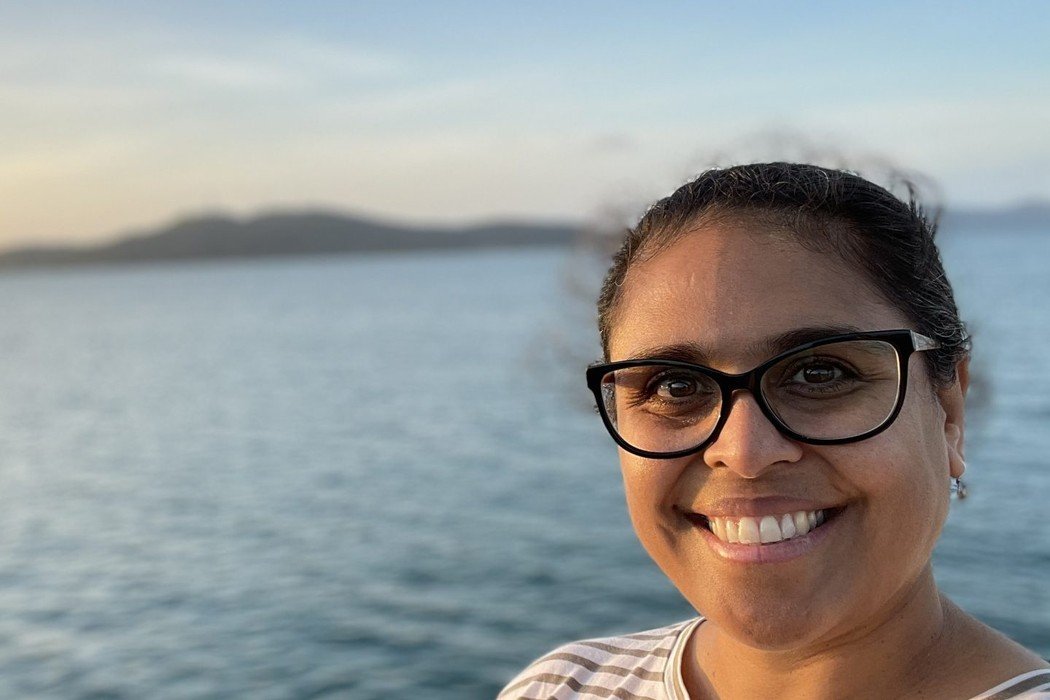
As a primary-school child, watching the news every night, she noticed that no one on the screen looked like her, and that the news rarely showed her community in a positive light.
UQ Contact magazine, August 2022
On Sunday 6 September 2026, Rhianna Patrick asked the room at Mitchelton who tells Australian stories, whose voices the record keeps, and what changes when First Nations people control the microphone. As a primary-school child she watched the nightly news and saw no one like her on it. She went on to read the news on ABC national radio, present Speaking Out, and lead audio and podcasts at IndigenousX.
A thematic set of ingredients to read, watch, hear, and explore, chosen to follow up a Truth-Telling session. Start with twenty minutes of Rhianna’s own work below, then follow the four threads over the weeks ahead.
About Learning CompanionsRhianna hosted Hi, I’m Eddie, a six-part podcast the State Library of Queensland made in 2022 to mark thirty years since the Mabo decision. It won Gold for Best Indigenous Podcast at the 2022 Australian Podcast Awards. Episode one, Pearls Dropped in the Ocean, runs twenty minutes, with Gail Mabo among its guests.
Listen for who tells the story. Family, community members, and the lawyer who stood beside Eddie speak for themselves, and a Torres Strait Islander journalist holds the microphone.
Listen to Hi, I’m EddieThe State Library page plays every episode. The series also streams free on Apple Podcasts and Spotify.
What changes when a Torres Strait Islander journalist tells a Torres Strait Islander’s story?
Four ideas run through Rhianna’s published interviews and her work on air.
As a primary-school child, watching the news every night, she noticed that no one on the screen looked like her, and that the news rarely showed her community in a positive light.
UQ Contact magazine, August 2022“I believe in the voices and the sovereignty of our own media.”
In the same interview she argued that First Nations media needs proper funding and support to stand on its own.
UQ Contact magazine, August 2022From 2008 to 2014 she presented and produced Speaking Out, the ABC’s flagship Indigenous affairs program, carrying First Nations voices and stories to national radio.
UQ School of Communication and Arts, 2020With Gomeroi journalist Madeline Hayman-Reber she co-hosted Blak Bias, which examines how Australian media treats Indigenous expertise as bias. The series drew on research by Professor Heidi Norman and Archie Thomas at the University of Technology Sydney.
Rhianna’s programs on our listening listEach selection opens a different side of the same question: who reports, who speaks on screen, who sets the frame, and who was written about. Begin with whichever draws you in, and return to the others when a question sends you looking.
The Wiradjuri journalist’s reckoning with growing up Aboriginal in Australia, written after his speech on racism and the Australian Dream. Direct and personal, and written for the reader who says “I never knew.”
The connection. Like Rhianna, Grant built his career inside mainstream newsrooms. His book asks what a First Nations journalist sees from inside the national story, and what it costs to tell it.
What does a reporter see from inside a story that an outsider misses?
Borrow or buy the book. It sits among the memoirs on the reading list, beside Archie Roach and Anita Heiss.
Karla Grant, host of Australia’s longest-running Indigenous current affairs program, talks with Network 10 presenter Narelda Jacobs about how she found her voice in the media.
The connection. Two First Nations women hold the microphone on national television, a generation after a schoolgirl saw no one like her on the evening news.
What does it take to speak in your own voice on a national broadcast?
Free with an SBS account in Australia. Streaming availability can change.
The first episode of Rhianna’s own series. Lorena Allam, Indigenous affairs editor at Guardian Australia, talks about Indigenous journalism in a crisis: COVID in western New South Wales, the floods, and mainstream coverage that blamed the people it reported on.
The connection. Rhianna’s session asked what changes when First Nations people control the microphone. This episode answers with cases: the reporting changes when the reporters belong to the communities they cover.
When a crisis hits a First Nations community, whose reporting would you trust first, and why?
All six episodes sit in 2SER’s Fourth Estate podcast feed, in any podcast app.
Millions of digitised newspaper pages from 1803 onward, many free to read. Search a Brisbane suburb you know, limit the years to 1840 to 1900, and read how the papers described the First Nations people who lived there. Then open today’s Koori Mail or National Indigenous Times and read the same subject reported by First Nations journalists.
The connection. Rhianna asked whose voices the record keeps. In the colonial press, settlers did the writing, and First Nations people appear far more often as the subject than as the speaker.
Whose voice speaks in the article, and whose voice is missing from it?
Historical newspapers reproduce the racism of the people who wrote them, and the State Library guide explains what to expect before you search.
On 6 April 1993, 98.9FM went to air in Brisbane as the first Indigenous radio station in an Australian capital city. Rhianna worked there as breakfast announcer and rugby reporter while she studied. The station now broadcasts from West End, and its weekday program Let’s Talk, from 9 to 10 in the morning, carries Indigenous current affairs from Brisbane to the nation.
Listen to one morning of Let’s Talk, then to the commercial news bulletin you usually hear. Which one asks First Nations people what they think, and which one tells you what to think about them?
Think of one story about First Nations people you heard in the news this year. Who told it, whom did they ask, and who held the microphone?
Keep a few notes, talk it through with a friend, or tell us what Rhianna’s session opened up for you. The aim is to notice who speaks, and to seek out the First Nations voices that report for themselves.
Tell Us What You Took AwayEach learning companion asks the same question in a different place: who holds the authority to tell a First Nations story? Follow it from the Country beneath Brisbane, to the lives the State controlled, to the microphone, to the courts and prisons that decide First Nations women’s lives.
About this learning companion. Truth-Telling at Mitchelton prepared this learning companion in October 2026 to follow up Rhianna Patrick’s session on 6 September 2026, drawing on her published interviews and programs and on our own Reading, Viewing, Listening, and Websites lists. We chose the selections and wrote the questions.
Country and cultural knowledge. Rhianna’s family connections run to the Zagareb clan of Mer and the Wagadagem clan of Mabuyag in the Torres Strait. Meanings and authority belong to particular peoples and places. Public access to a recording or website transfers no ownership of the knowledge within it.
Cultural advice. Linked works may include the names, images, and voices of people who have died, and accounts of racism in the media. Follow the advice each publisher or platform provides.
Go further with Rhianna. Hi, I’m Eddie · Her programs on our listening list · Rhianna’s story on our site
Prepared 9 October 2026. Every link was opened and checked on 9 October 2026; access to each player depends on its platform.