Held at Mitchelton Library

Photograph: DVConnect
Brisbane once barred Aboriginal people from its centre after four each afternoon and all day Sunday. Aunty Heather Castledine began a walk along the old boundary so the city would remember.
A Kamilaroi-Kooma Elder, social worker, and long-serving Aboriginal Co-Chair of Reconciliation Queensland, Aunty Heather has spent decades turning hidden history into public knowledge.
Aunty Heather is a proud Kamilaroi-Kooma woman. Born in St George in south-west Queensland, she grew up one of nine children and descends from the Hooper family of Cunnamulla. Her family struggled, but they always sat down together. Years later she made Logan her home. “I came down and fell in love with this place,” she has said. “Logan is where I want to be.”
She grew up in a country town segregated by race. For twenty-seven years she worked in the outback, on cattle and sheep stations, in shearing sheds, and in earth-moving camps at the back of Bourke.
Then she turned to study. She completed a Bachelor of Social Work at Deakin University in 2000, and in 2012 a Diploma of Community Services in community organisation and advocacy at Metro North TAFE. She also holds a Certificate IV in Indigenous Leadership. Since 2004 she has served Queensland Health as Aboriginal Cultural Consultant to the clinicians of the Metro South Child and Youth Mental Health Service. She trains Queensland Health staff in cultural practice across Metro South and builds clinical pathways for Aboriginal and Torres Strait Islander young people.
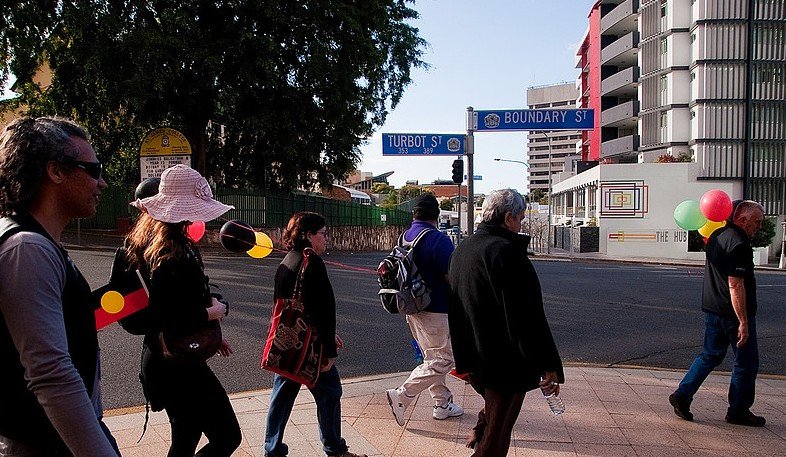
Two Boundary Streets in central Brisbane still mark the line colonial authorities forbade Aboriginal people to cross after four in the afternoon and on Sundays, and mounted police enforced it. In 2009, the year after the National Apology to the Stolen Generations, Aunty Heather began the Boundary Street to Boundary Street walk, so that the city’s curfew would not become, in her words, “a hidden history.”
The curfew reached well into living memory. “Right up until the 1960s,” she told 4EB Brisbane in 2019, “our aunties and uncles were still being stopped in the street on their way from the Valley into the city and asked what they do and why are they going into the city after dark.”
Changing the name wouldn’t change history, but it’s acknowledging it and letting people know, this is what happened.
Aunty Heather Castledine, Yahoo News Australia, 14 June 2020
Read the National Indigenous Times on Brisbane’s Boundary Streets
As Aboriginal Co-Chair of Reconciliation Queensland, she became one of the state’s best-known voices for reconciliation. She held governments to their word: in 2010 she pointed out that governments had implemented only “a handful” of the fifty-four recommendations of the Bringing Them Home report.
“If people were told about it,” she has said, “it would make a big difference. But when you don’t know how can you change it?”
Aunty Heather has given years of service on the boards of organisations that serve her community. She joined the board of Logan District Aboriginal and Torres Strait Islander Elders in 2006 and has served on the management board of Murrigunyah, an Aboriginal and Torres Strait Islander women’s sexual assault service. From 2013 to 2022 she served as a Director of YFS in Logan, where she guided its Reconciliation Action Plan. She sat on the board of DVConnect, Queensland’s domestic and family violence crisis service, for more than eight years, then served as its First Nations Cultural Advisor for three more. DVConnect described her as “kind, generous, and incredibly committed.”
Logan City Council honoured her with the Mayor’s Spirit of Logan Award.
Aunty Heather joins a strong line of speakers. Since 2019, Elders and Cultural Custodians, historians, authors, and community leaders have stood where she will stand.
See All Recent Speakers