Acknowledgement We acknowledge the Traditional Custodians of the Country on which we gather, the Yuggera and Turrbal peoples of Magandjin/Meanjin, and their continuing connection to land, waters, and skies. We pay our respects to their Elders past and present, and to all First Nations Peoples, whose cultural knowledge remains in their own custodianship. Sovereignty never ceded.
Queensland closed its Truth-telling and Healing Inquiry in November 2024. Local truth-telling continues at Mitchelton Library, filling part of the void that closure left. These are the terms on which we do it.
Cultural Advice and Content Warning
Aboriginal and Torres Strait Islander visitors are advised that these pages describe frontier violence, removals from Country and family, and deaths in custody, and that they contain images and names of people who have died. 13YARN, the national First Nations crisis support line, answers on 13 92 76, day and night.
"That was a long time ago"
People say it kindly, and they say it often: the frontier, the missions, the removals, all of it happened long ago, so why gather on a Sunday afternoon to hear about it still?
Oodgeroo Noonuccal answered that question in her poem, The Past.
Let no one say the past is dead.
The past is all about us and within.
Haunted by tribal memories, I know
This little now, this accidental present
Is not the all of me, whose long making
Is so much of the past.
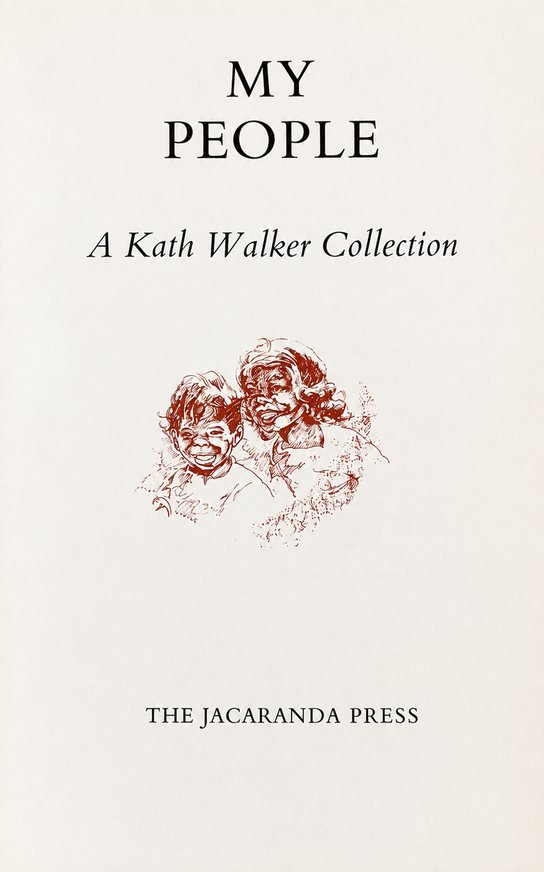
Oodgeroo Noonuccal, the opening lines of The Past, from My People (Jacaranda Press, 1970), published under the name Kath Walker. She reclaimed her Minjerribah language name in 1988, in protest at the Bicentenary: Oodgeroo means ‘paperbark tree’, and Noonuccal is her people of Minjerribah.
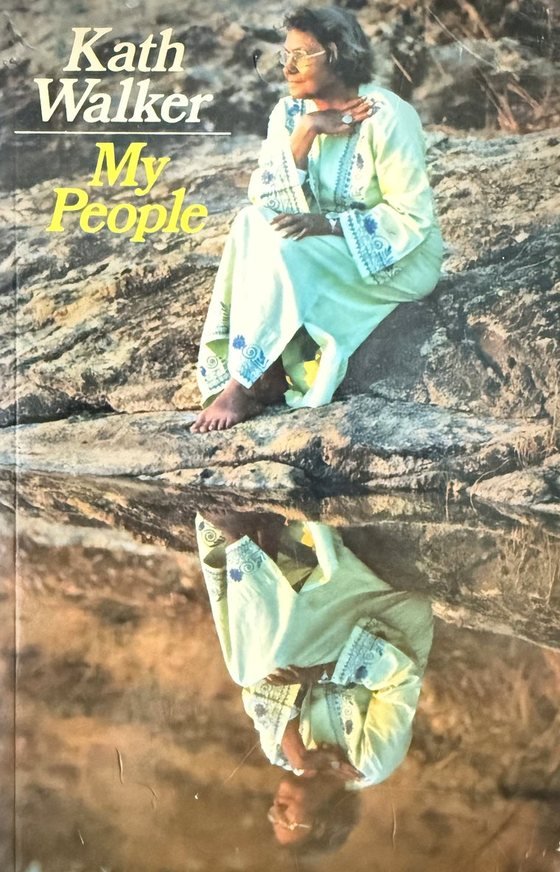
Linda Harnett’s copy of My People, the Jacaranda Press collection in which The Past appeared in 1970, eighteen years before Oodgeroo Noonuccal reclaimed her language name. The cover photograph shows a person who has died.Kath Walker, and Oodgeroo Noonuccal Click to open: why she changed her name, and when
She was born Kathleen Jean Mary Ruska at Bulimba in 1920, and grew up at One Mile on Minjerribah, North Stradbroke Island, on Noonuccal Country. Publishing as Kath Walker, her married name, she became in 1964 the first Aboriginal Australian to publish a book of verse. The Crown appointed her MBE in 1970 for services to the community, an honour she accepted in the belief that it would draw attention to Aboriginal causes.
She returned the MBE in protest at the approaching Bicentenary, asking what, from an Aboriginal point of view, there was to celebrate. In 1988 she took her Minjerribah language name: Oodgeroo, meaning ‘paperbark tree’, the bark her people used for drawing, of the Noonuccal people of Minjerribah. Her sons took language names in the same period. She died in 1993.
Because The Past appeared in 1970, the book pictured above names her as Kath Walker. Her original language name is the one to use now.
The past has not gone anywhere. It surrounds us, it lives within us, and this present moment holds the long making of everything that came before it.
Colonial decisions sit embedded in the institutions of Australian government and culture, because those institutions came into being to reflect and hold colonial power, and the patterns persist.
Since the Royal Commission into Aboriginal Deaths in Custody reported in 1991, the rate at which governments and government-supported facilities imprison First Nations adults and children has risen rather than fallen, and institutionalised bias operates at the critical decision points along that path.
The past also lives inside the stories Australians tell about themselves. The bushman and the ANZAC stand at the centre of the national self-image, and they are settler Australia's stories. First Nations stories of the same country and the same decades sit outside the frame, and truth-telling moves them back inside it.
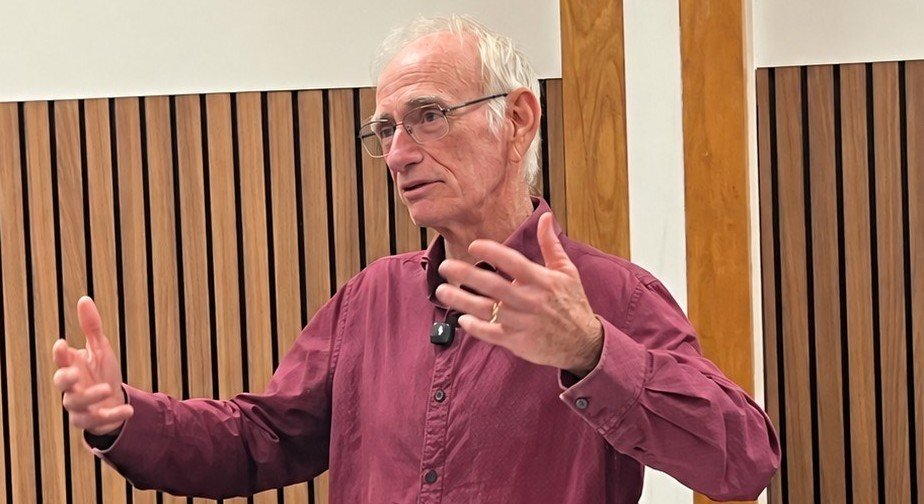
Dr Thom Blake, author of a definitive history of the Cherbourg settlement, speaking at Mitchelton Truth-Telling. Photograph: Philippe Foubert
The myth of peaceful settlement
The story of peaceful settlement is a myth. It denies First Peoples' ownership of this land. It denies the orchestrated violence that dispossessed them. It denies the attempted erasure of Aboriginal and Torres Strait Islander cultures: removal from Country, the criminalising of language and ceremony, and the taking of children into settlements such as Cherbourg.
Much of this required concealment. The murders went unrecorded, the repression went unnamed, and the dispossessed were blamed and shamed for the very impoverishment that dispossession produced, so that the settler society could take the lands, benefit, and grow wealthy on that land, and tell itself it was peacefully settled.
Australians inherited the cover-up along with the benefit. Naming that plainly is where repair begins.
Where this Mitchelton gathering sits
The Path to Treaty Act 2023 set out three stages for Queensland.
Stage One placed local truth-telling in the hands of communities, supported by the Interim Truth and Treaty Body.
Stage Two established the Truth-telling and Healing Inquiry, which began hearing evidence across the state on 1 July 2024.
Stage Three created the First Nations Treaty Institute to prepare the ground for treaty.
On 28 November 2024 the Queensland Parliament passed the repeal of the Act. The Inquiry and the Institute ceased. A formal record that would have gathered thousands of Queensland stories now stops at the submissions already lodged.
Yet Stage One never depended on the legislation: communities can research, record, and share their own histories whatever a parliament decides.
On the first Sunday of every month at Mitchelton Library, we do exactly that.
What we do
From communities across Magandjin/Meanjin (Brisbane) we gather to listen, to learn, and to bear witness to the true history of this country, and to the world's oldest living culture, continuous for more than 65,000 years.
Each month an Aboriginal Elder and Cultural Custodian, historian, academic, community leader, or activist leads the session. They bring lived experience, cultural knowledge, and historical research.
Admission is free and everyone is welcome.
What you gain by coming
Local history nobody taught you. The education system across Australia intentionally never taught you the accurate version of Australian history. You will hear it here from the people who lived it, their descendants, or researchers.
Hidden histories brought into the light. Including individual achievement, culture, and endurance won against structural barriers.
A First Nations perspective. Stories of the events told from the other side of the frontier.
Personal stories of separation, search, and reunion. Told by the people who lived them, or their descendants who hold the family story, and the validation that lived experience receives when a room listens.
A safeguarded record. Recordings, made only with consent, that protect local oral histories, family histories, and their connections to Country for the generations coming. Through an agreement with the State Library of Queensland, these recordings form a special Local Truth Telling Collection, to be made available to teachers, researchers, and the public.
The line from policy to outcome. Exposure of what discriminatory policy did, and of what it still does.
The chance to show support. Respectfully listening while a speaker tells their story, their truth, is itself an aspect of healing, for them and the audience.
A demonstrated commitment to justice. Attendance in person says that First Nations justice matters to you.
Motivation that lasts past Sunday. What you hear will likely encourage you to advocate for institutional and structural change.
Relationships. Between Indigenous and non-Indigenous peoples, built the only way relationships are built, by showing up repeatedly.
Join a community. The regular sessions create the possibility of becoming part of a socially rewarding, like-minded community.
Our standing commitments
1. First Nations people set the terms.
Speakers decide what they tell, how they tell it, and what stays off the record. Self-determination governs the program.
2. We tell the good as well as the hard.
This history holds survival, leadership, knowledges, artistry, scholarship, and humour. A program of grief alone would misrepresent the people whose history we tell.
3. We work at the pace of trust.
Truth-telling takes years. Relationships built slowly and kept carefully outlast any single event.
4. We hold the room safely.
Each session opens with a plain content note, nobody faces pressure to disclose anything, anyone may leave at any moment, and support contacts remain visible for the whole session.
5. We record only with consent.
The speaker decides what we keep, what we publish, and what we don’t publish.
6. We keep the focus local.
Primarily the stories are Queensland based, with many around Brisbane and surrounding areas. Named places, named events, and named people where possible.
7. We stay open to all.
No fee, no membership, no prerequisite, and no questions.
Get involved
The series runs on community. You can help in these ways:
Volunteer. Setting up the room, welcoming at the door, and managing refreshments all need people, and your help once a month makes the afternoon run smoothly.
Come, and bring one person. Attendance is itself a contribution, and each new listener widens the circle.
Partner. Community groups, schools, churches, and local organisations that want to bring truth-telling to their own people can build on what this series has learned.
Contribute. Teralba Park Community Group offer a First Nations Community Library, co-located at Mitchelton Library before and after the truth-telling sessions. You are welcome to contribute books, or simply borrow, read, and return them.
To support First Nations justice, you may choose one of these actions:
This week
Learn which First Nations Country your house occupies.
Read one book from Important Works, borrow one from the Stories for Healing lending library that sets up outside the entry at each session, or watch one documentary from Must-See Films and Documentaries.
Tell one person what you heard at a Mitchelton session.
Subscribe to one First Nations news source, so First Nations reporting reaches you every week without further effort. Key Websites and Archives names several.
This month
Set up a small monthly donation to an Aboriginal and Torres Strait Islander community-controlled organisation. A small regular amount lets them plan.
Support a First Nations-led organisation by turning up to one of their events. The First Nations Community Calendar lists community, culture, and ally events across South-East Queensland, checked with the organisers and updated every Friday.
Write to your member of parliament about one specific thing, for example: the Social Justice Report recommendations (federal member), the minimum age of criminal responsibility (state member), or dual naming and interpretive signage in your own suburb (local member).
Offer a professional skill without charge, on the organisation's terms.
Ask one First Nations organisation what they need, rather than deciding what would help.
Make a written submission to a parliamentary inquiry, a council process, or a Reconciliation Action Plan where you work.
Ask your state and federal members, on the record, where they stand on treaty and truth-telling in Queensland. Keep the answer, and compare it later with how they vote.
Bring truth-telling into an institution where you already belong: a workplace, school, church, club, or body corporate. Invite a speaker, or start a reading group.
Vote with these questions in front of you.
Coming to a session
When: the first Sunday of each month. Doors open at 2.00 pm for a 2.30 pm start.