Acknowledgement We acknowledge the Traditional Custodians of the Country on which we gather, the Yuggera and Turrbal peoples of Magandjin/Meanjin, and their continuing connection to land, waters, and skies. We pay our respects to their Elders past and present, and to all First Nations Peoples, whose cultural knowledge remains in their own custodianship. Sovereignty never ceded.
Every book in the first section comes from a First Nations author or teller, and every documentary in the viewing list has First Nations people directing it or leading it on screen. Works by non-Indigenous historians sit in their own clearly marked section. Start anywhere: each entry stands alone, and one book or one documentary, as the Charter says, is a real beginning.
Cultural Advice and Content Warning
Aboriginal and Torres Strait Islander visitors are advised that several of these works describe frontier violence, child removal, and deaths in custody, and some contain images, voices, and names of people who have died. 13YARN, the national First Nations crisis support line, answers on 13 92 76, day and night.
The full text, under five hundred words · the Uluru Dialogue, UNSW
Thirteen First Nations Regional Dialogues ran from December 2016 to May 2017, and the roughly 250 delegates they chose met at Mutitjulu from 23 to 26 May 2017, where Megan Davis read the finished text aloud for the first time. Reading it takes four minutes. The Statement declares that sovereignty has never been ceded, sets out the incarceration of First Nations people and the removal of their children as evidence of a structural problem rather than a personal failing, and then asks for two things: a First Nations Voice enshrined in the Constitution, and a Makarrata Commission to supervise agreement-making between governments and First Nations, and truth-telling about history. Truth-telling in this country begins with that request. The Referendum Council's final report, which records what every Dialogue said, downloads from the same page. Read the Statement first, then read everything else on this list.
The original Act, scanned page by page · Documenting a Democracy, National Archives
When a speaker says they grew up "under the Act", this is the Act. Nine pages passed by the Queensland Parliament in December 1897, more restrictive than any comparable law in the other colonies, creating the reserves, the Protectors, and the legal authority to move people, hold their wages, and take their children. Cherbourg, Palm Island and Woorabinda all follow from it. Read the preamble, which calls it protection, then read what the sections actually permit.
National Report in five volumes, plus regional reports · free PDFs from Australian Policy Online
Four years of hearings, ninety-nine deaths examined one by one, and a finding stated without hedging: in every case, facts associated with the person's Aboriginality played a significant and usually a dominant role in their being in custody and dying there. The Commission made 339 recommendations. Most were never implemented, and the imprisonment rate has roughly doubled since. Every volume downloads directly, including a regional report for Queensland, which is the one to open first if you want the deaths that happened here.
Two public records sit underneath much of the reading above, and reward a direct look rather than only a summary.
The 689-page report that gave the Stolen Generations their name in Australian law and policy, built from the testimony of more than five hundred Aboriginal and Torres Strait Islander people, with fifty-four recommendations still only partly implemented. Free to read or search at the Australian Human Rights Commission's website.
An interactive map, led by the late Professor Lyndall Ryan, that has verified more than 400 frontier massacres and published the sources behind each one. Searchable by place; several sites sit inside Queensland's own frontier, not far from home.
Submissions and testimony, 2024 · the record of an inquiry the Parliament closed
The Inquiry began hearing evidence on 1 July 2024 and was abolished by the repeal of the Path to Treaty Act on 28 November 2024. What it had already gathered survives here: written submissions and the transcribed testimony of people who came forward while there was still somewhere to bring it. Three speakers from this series gave evidence, and their testimony is linked from their speaker cards. This library is why these gatherings continue.
Final reports tabled in the Victorian Parliament, 1 July 2025 · free to read and download
Victoria gave a truth-telling body the powers of a royal commission and let it work for four years. Yoorrook took more than 1,300 submissions, sat 67 days of public hearings with over 250 witnesses, and compelled more than 7,000 documents from the State. Truth be Told sets down the official public record of colonisation in Victoria, and finds that the killings, disease, sexual violence, and child removal from 1834 onward brought about the near-complete destruction of First Peoples there, which the Commission names as genocide. Yoorrook for Transformation follows with 100 recommendations covering land, education, housing, health, access to records, and political life. Queensland's inquiry closed before it could finish. These volumes show what a completed one produces.
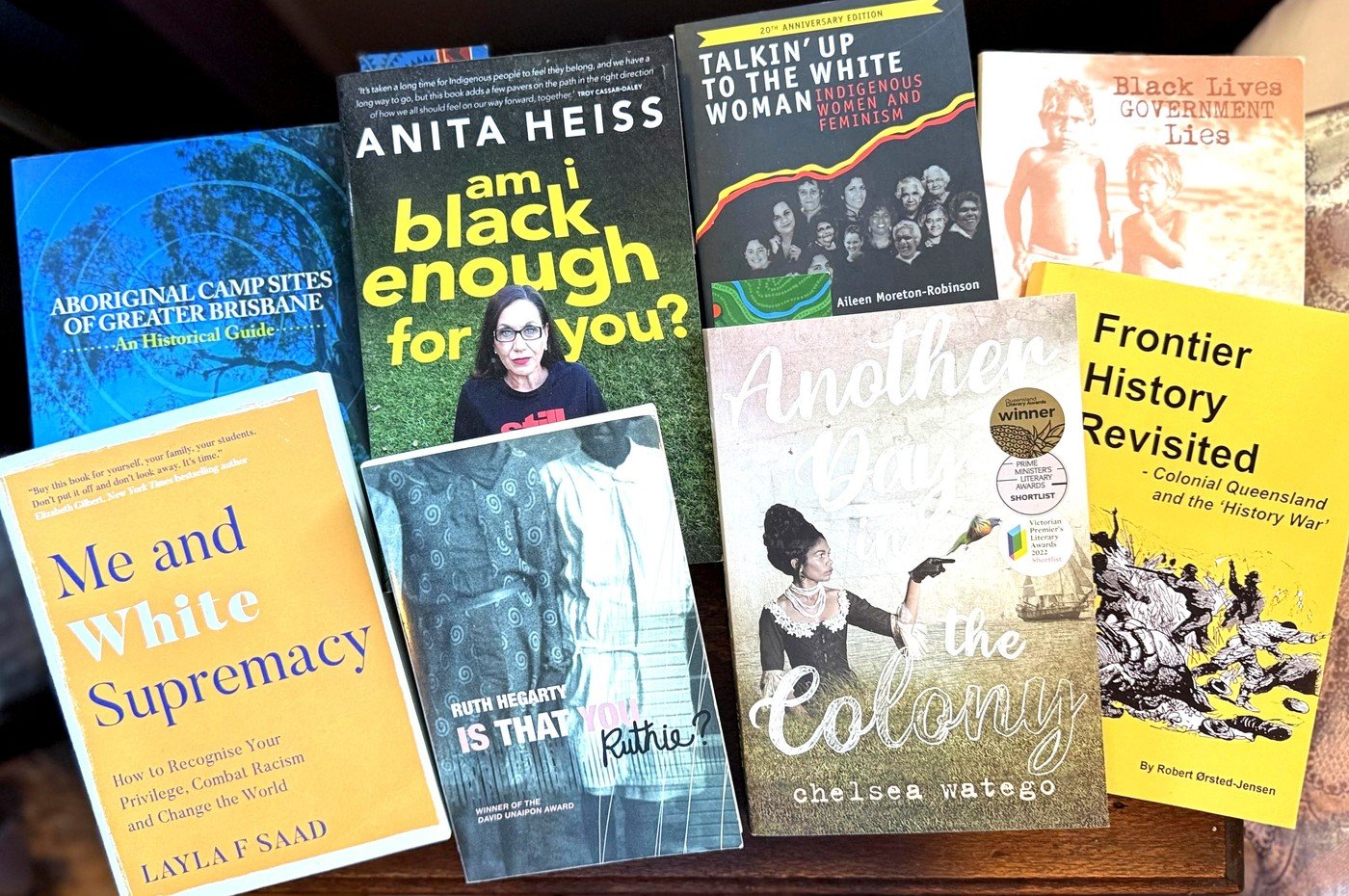
Some excellent First Nations reading, in our household. Photograph: Philippe Foubert
Begin close to home
Not Just Black and White
Lesley Williams and Tammy Williams (UQP, 2015)
A Murri mother and her daughter tell the story of Aunty Lesley's childhood under the Act at Cherbourg, her years of domestic labour for stolen wages, and her long public campaign for justice. It won the David Unaipon Award, and Aunty Lesley has spoken at these very Mitchelton sessions, so the voice in these pages is one this community has heard in the room. If the lists begin anywhere, they begin here.
My People
Oodgeroo Noonuccal (first published 1970; current edition Wiley)
The Charter quotes her poem "The Past" for good reason. Oodgeroo of the Noonuccal, of Minjerribah just across the bay, gave this country its first widely read Aboriginal poetry collection, and the poems run from protest to tenderness in language nobody needs a footnote to feel.
Too Much Lip
Melissa Lucashenko (UQP, 2018; winner, 2019 Miles Franklin Award)
A Goorie novelist from Brisbane won the Miles Franklin Award with this fierce, funny novel of a Bundjalung family fighting for their river country. Fiction, and utterly local truth-telling: the humour the Charter promises alongside the hard history.
Edenglassie
Melissa Lucashenko (UQP, 2023)
The same Goorie novelist as Too Much Lip, now writing Brisbane itself. Two stories five generations apart: Mulanyin and Nita in the 1850s, when the saltwater people still outnumbered the British and the town was called Edenglassie, and Granny Eddie in the present, telling a white journalist that the version of this history he was taught is wrong. Winner of the ARA Historical Novel Prize and a Victorian Premier's Literary Award. For a Brisbane audience this is the essential novel on the list: the streets in it are the ones outside the library door.
Aboriginal Camp Sites of Greater Brisbane: An Historical Guide
Ray Kerkhove (Boolarong Press, 2015)
Fifteen camps mapped across the city, with a suburban listing at the back, covering the grounds Aboriginal families used from convict times until the 1950s. Brisbane suburbs take their names, their parks and their histories from these places. Read it alongside a street directory and the city stops looking like a city built on empty land.
Memoir and testimony
Talking to My Country
Stan Grant (HarperCollins, 2016)
The Wiradjuri journalist's reckoning with growing up Aboriginal in Australia, written after his viral speech on racism and the Australian Dream. Direct, personal, and written for exactly the reader who says "I never knew."
Tell Me Why
Archie Roach (Simon & Schuster, 2019)
The beloved Gunditjmara and Bundjalung singer was taken from his family at two years old. His memoir travels the whole arc, removal, homelessness, music, and healing, with the generosity that made "Took the Children Away" a national hymn.
Follow the Rabbit-Proof Fence
Doris Pilkington Garimara (UQP, 1996)
The Martu author tells her own mother's story: three girls who escaped a removal settlement and walked 1,600 kilometres home along the fence. A short book, and one of the most widely shared accounts of the Stolen Generations ever written.
Is That You, Ruthie?
Ruth Hegarty (UQP, first published 1999; now in UQP's First Nations Classics series with an introduction by Jackie Huggins)
Winner of the David Unaipon Award, this is close to the memoir to which Not Just Black and White replies: a four-year-old girl's whole childhood inside the dormitory system at Cherbourg, and the domestic service that followed it. Read the two together and one Cherbourg story becomes two, which is closer to the truth. A sequel, Bittersweet Journey, follows Ruth's life after the Mission.
Growing Up Aboriginal in Australia
edited by Anita Heiss (Black Inc., 2018)
Fifty First Nations voices, from Elders to teenagers, each answering the same question in a few pages. Ideal for a reader unsure where to start, or for reading one story a night; the range itself is the lesson.
A Wiradjuri woman answers the question strangers keep asking her, and the answer became a memoir of identity, family and the Bolt case that followed. She edited Growing Up Aboriginal in Australia, listed above; this one is her own story.
Understanding, culture, and thought
Welcome to Country: A Travel Guide to Indigenous Australia
Marcia Langton (Hardie Grant, 2nd edition 2021)
The Yiman and Bidjara scholar's plain-language guide to First Nations Australia: history, kinship, native title, art, and protocol, organised region by region. The reference book for the questions people hesitate to ask aloud.
Finding the Heart of the Nation
Thomas Mayo (Hardie Grant, 2019)
A Kaurareg Aboriginal and Kalkalgal, Erubamle Torres Strait Islander author travelled the country with the Uluru Statement from the Heart, gathering the voices behind it. The referendum did not end the Statement's invitation, and this book explains it from the inside.
The Voice to Parliament Handbook
Thomas Mayo and Kerry O'Brien (Hardie Grant, 2023)
Written for the referendum itself, in plain, patient language, by the same Torres Strait Islander advocate and the veteran journalist who has covered Indigenous affairs for decades. The 2023 vote did not go the way its authors hoped; the book remains the clearest record of what was actually being asked, and why, for readers still working through that question.
Sand Talk: How Indigenous Thinking Can Save the World
Tyson Yunkaporta (Text, 2019)
An Apalech man's exhilarating tour of Indigenous knowledge systems, argued through yarns, carvings, and pattern-thinking. The book on this list most likely to rearrange how a professional reader thinks about thinking.
Fire Country
Victor Steffensen (Hardie Grant, 2020)
A Tagalaka fire practitioner explains cultural burning: what the old people knew about caring for this continent with fire, and what it offers a country now burning the wrong way. Practical, hopeful, and increasingly influential.
Talkin’ Up to the White Woman: Indigenous Women and Feminism
A Goenpul woman of Quandamooka turns the lens around and examines white feminism as the subject rather than the standard. Twenty-five years on, the book still sets the terms for how whiteness gets studied in this country.
Another Day in the Colony
Chelsea Watego (UQP, 2021)
Essays by a Munanjahli and South Sea Islander scholar on living inside a colony that insists it has ended. She refuses the language of reconciliation and closing gaps, and writes instead about what survival costs and what it takes.
Fiction that tells the truth
The Yield
Tara June Winch (Penguin, 2019)
A Wiradjuri novel built around a grandfather's dictionary of his language, each word opening a piece of family and colonial history. Winner of the Miles Franklin Award, and the most moving argument in recent Australian writing for what language holds.
A Waanyi woman from the Gulf Country in Queensland's far north-west, Wright is the only Aboriginal author to win the Miles Franklin Award twice, first for Carpentaria in 2007 and again in 2024 for the seven-hundred-page Praiseworthy, which also won the Stella Prize the same year. Neither book is an easy read, and neither wants to be; both reward the reader who stays with them, in a voice unlike anything else in Australian fiction.
After Story
Larissa Behrendt (UQP, 2021)
A Eualeyai and Kamillaroi lawyer and filmmaker sends an Aboriginal mother and her lawyer daughter on a literary tour of England, and lets the colonisers' literature and the family's own story illuminate each other. Warm, wry, and quietly devastating.
Non-Indigenous historians, clearly marked
Know Their Names: The Queensland Government's Aboriginal Workers and the System That Exploited Them
Lesley Synge (Zing Stories, 2024)
Synge spent three years recovering the names of the Aboriginal stockmen who bred the horses for the Queensland Police at Rewan Station on Bidjara Country, from 1909 until the government closed it and auctioned the horses in 1934. The state called its white workers constables and its Aboriginal workers trackers, and left their names almost unrecorded. She found them: Corporal Rob, Prince Albert, Boolboora-Leo Freeman, Jack Splinter, and the Woorabinda drovers. The final part turns on the officials in Brisbane's Treasury Building who ran the system. Synge spoke at Mitchelton, and this is the book on erasure as a method of government.
Warrior: A Legendary Leader's Dramatic Life and Violent Death on the Colonial Frontier
Libby Connors (Allen & Unwin, 2015)
The definitive account of Dundalli, the Dalla lawman who led resistance across south-east Queensland for twelve years and was publicly hanged outside the Brisbane gaol in January 1855. Connors, a legal historian, reads the colonial record against itself to show that what settlers called outrages were the operation of Aboriginal law, and that the trial which killed him had no lawful basis. Winner of the Queensland Premier's Award for a work of State Significance and the Magarey Medal for Biography. The local frontier history, told properly.
Truth-Telling: History, Sovereignty and the Uluru Statement
Henry Reynolds (NewSouth, 2021)
The historian who did most to document the frontier wars addresses truth-telling directly: what the record shows, and what follows from it. A natural companion to the purpose of these sessions.
Killing for Country: A Family Story
David Marr (Black Inc., 2023)
Marr discovered his own ancestors served in the Native Police, and wrote the history of Queensland's frontier through his family's part in it. For a Queensland audience, the book that shows what honest settler reckoning looks like.
The Secret War: A True History of Queensland's Native Police
Jonathan Richards (UQP, 2008)
Ten years in the state archives produced the first full account of the Native Police: mounted Aboriginal troopers under white officers who cleared the Queensland frontier through killing that had the government's implicit approval and, just as often, its concealment. David Marr's own ancestors served in this force; Richards' book is the wider history within which his family memoir sits.
Conspiracy of Silence: Queensland's Frontier Killing Times
Timothy Bottoms (Allen & Unwin, 2013)
A Cairns historian's systematic, place-by-place record of the massacres that accompanied Queensland's pastoral expansion, roughly 140 documented sites between 1831 and 1918, with conservative estimates of tens of thousands of Aboriginal deaths. Confronting precisely because it refuses to generalise: it names places, several within a few hours' drive of Mitchelton.
The Biggest Estate on Earth
Bill Gammage (Allen & Unwin, 2011)
A meticulous account, from colonial records themselves, of how Aboriginal people managed this continent as a designed and cared-for estate. Read alongside Fire Country, and alongside the Dark Emu conversation below.
Dark Emu
Bruce Pascoe (Magabala Books, 2014)
The bestseller that put Aboriginal agriculture and settlement into national conversation, and also drew sustained scholarly debate about its evidence and claims. Read it as the start of an argument rather than the end of one, and watch The Dark Emu Story in the viewing list, which airs the debate fairly from First Nations perspectives.
Frontier History Revisited: Colonial Queensland and the ‘History War’
Robert Ørsted-Jensen (Lux Mundi, Brisbane, 2011)
A Danish-born historian works through the Queensland records and puts numbers to the frontier, arguing that the killing here ran far beyond what the history wars conceded. Dense with sources, and written to be checked.
Black Lives, Government Lies
Rosalind Kidd (UNSW Press, 2000)
Sixty pages drawn from the Queensland government’s own Aboriginal affairs files, by the historian who was given access to them. Wages withheld, savings taken, children moved, all of it recorded by the department that did it. The paper trail behind the stolen wages claims.
Suggest a Book
These lists grow, and First Nations recommendations especially shape what joins them. The Teralba Park First Nations Community Library at Mitchelton Library holds many of these titles for borrowing.
Suggestion details are used only to consider the work for the lists, and we never share them.