Acknowledgement We acknowledge the Traditional Custodians of the Country on which we gather, the Yuggera and Turrbal peoples of Magandjin/Meanjin, and their continuing connection to land, waters, and skies.
We pay our respects to their Elders past and present, and to all First Nations Peoples, whose cultural knowledge remains in their own custodianship. Sovereignty never ceded.
Held at Mitchelton Library
Truth-Telling

Seeing Country Beneath the City

A Companion to Brett Leavy’s Session · Sunday 4 October 2026
Start Here Read Watch Listen Explore Brisbane

You know Brisbane by its streets, buildings and suburbs. Brett Leavy’s digital reconstructions invite you to recognise the Country beneath them: the river and creeks, the vegetation, the gathering places, and the people whose connections continue.

Brett Leavy
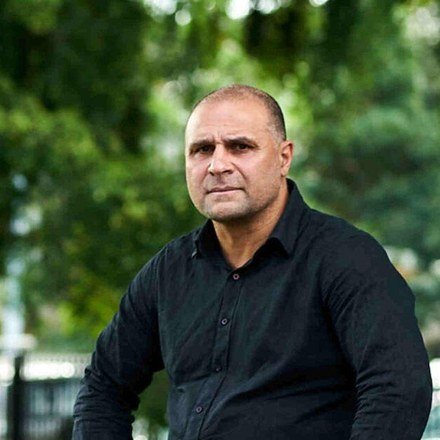
Brett LeavyKooma man, digital artist, and creator of Virtual SonglinesPhotograph: Australian National Maritime Museum, 2024Read Brett’s story
Start here · Ten minutes

Watch the Brisbane River before the city

Maiwar (2015) Dreaming. Video: Bilbie XR Labs. Press play to watch it here, or open it on YouTube below.

Brett’s Virtual Songlines team rebuilt Maiwar, the Brisbane River, as it ran before colonisation, from the Botanic Gardens reach to the Story Bridge. His own channel titles the video Maiwar (2015) Dreaming, and ACMI shares it as the trailer for Virtual Songlines.

Notice what changes when the buildings no longer dominate the view, and what you want to ask Brett at the session.

Watch It on YouTube

ACMI’s 2020 interview with Brett, with video and a full transcript, introduces his approach; the projects have grown since then. Open the ACMI interview and transcript.

Bring this question

What changes when you recognise Brisbane as living Aboriginal Country, and when First Nations people control how that Country and its stories are represented?

A little curiosity is all you need. The longer selections below are for the coming weeks; nothing needs finishing before the session.

Four Ways to Keep Exploring

Each selection opens a different part of the same conversation: place, story, representation and authority. Begin with whichever draws you in, and return to the others when a question sends you looking.

01 · Read · From our reading list

Edenglassie

Melissa Lucashenko · UQP, 2023 · A novel for the coming weeks

Lucashenko sets two Brisbane stories five generations apart: Mulanyin and Nita in the 1850s, when the town was still called Edenglassie, and Granny Eddie in the present, telling a journalist that the history he was taught is wrong. First Nations lives, relationships and futures hold the centre of the novel, and its streets are the ones outside the library door.

The connection. Brett rebuilds the city’s Country in a game engine; Lucashenko rebuilds it in fiction. Both ask you to see familiar streets differently. Read the novel as an imaginative work informed by history, with its own way of making that history felt.

As you read

How does a place change when the story begins with the people already living there?

Borrow or buy the book. UQP’s book club notes are a free companion to the novel, not the novel itself.

02 · Watch · From our viewing list

Ablaze

Tiriki Onus and Alec Morgan · 2021 · Documentary, 81 minutes

Tiriki Onus tracks down a lost 1946 film reel and uncovers his grandfather Bill Onus’s forgotten work as one of Australia’s first Aboriginal filmmakers and a leading civil rights campaigner. A family investigation becomes a story about who creates images, whose work survives, and who gets remembered.

The connection. Set this earlier use of film beside Brett’s digital reconstructions. The tools change; the question of who tells the story remains. Ablaze is a thematic companion, not a documentary about Virtual Songlines.

After watching

What difference does it make when First Nations people create and interpret their own images?

Free with an SBS account in Australia, and also free on ABC iview. Streaming availability can change.

03 · Listen · From our listening list

Who controls the knowledge?

Blak Nation, hosted by Rhianna Patrick · IndigenousX · The discussion of Indigenous Data Sovereignty

Our speaker of 6 September 2026 talks with Maggie Walter, Maui Hudson, Jane Anderson and Kalinda Griffiths about Indigenous control over data: what gets recorded, how it is interpreted, and who uses it.

The connection. A question from September travels into October. When cultural knowledge enters a digital project, who decides what is recorded, what is shared, and who benefits? The episode approaches sovereignty through data and policy; Brett’s session brings the same question to cultural representation.

After listening

What is the difference between being represented in a collection and having authority over it?

On the IndigenousX page, scroll to the sixth discussion, which opens “After decades of Indigenous policy failure”, and press its player.

04 · Explore · From our websites list

Gambay: First Languages Map

First Languages Australia · Free · Ten minutes to start

More than 780 languages, mapped with audio and video, on the first Australian map that lets communities control how their own languages appear in public. Choose a language entry with a recording and spend a little time with the people speaking.

The connection. Compare it with the map you use to get around Brisbane. Each map makes some things visible. Brett’s reconstructions invite the same attention to the knowledge a representation shows, and to the knowledge it leaves out.

As you explore

What does this map help you notice that a street map leaves out? Whose knowledge would you need to understand more?

Use the map as an introduction to languages and voices, not as a definitive boundary map or a substitute for local cultural authority.

Bring It Back to Brisbane

Choose one place you thought you knew

Ray Kerkhove’s Aboriginal Camp Sites of Greater Brisbane: An Historical Guide maps fifteen camps across the city, with a suburban listing at the back. Choose one documented location near you, then read about it alongside a present-day map.

What does its documented history reveal about the suburb, park or riverbank you recognise? What has the record preserved, and what might it leave out?

Kerkhove is a non-Indigenous historian. Read his research alongside First Nations accounts and local cultural authority. A documented camp site is not a licence to enter private or restricted land.

Find the Brisbane Guide on Our Reading List

A novel, a documentary, a conversation and a map offer different kinds of understanding. Ask of each: who made this, what evidence or experience informs it, and what can it help me understand?

One Question to Take Away

Choose a Brisbane place you thought you knew. What do you understand about it now, whose account helped you, and what do you still need to learn?

Keep a few notes, talk it through with a friend, or return to it after Brett’s session. The aim is to look more carefully, listen more closely, and recognise the continuing relationships that make a place Country.

Tell Us What You Took Away

About this companion. Truth-Telling at Mitchelton prepared it for Brett Leavy’s session on 4 October 2026, drawing on his publicly documented work and on our own Reading, Viewing, Listening and Websites lists. We chose the selections and wrote the questions; Brett did not set them, and nothing here transcribes his presentation.

Country and cultural knowledge. We use Country to recognise the relationships among people, land, waters, living things, knowledge and responsibility. Meanings and authority belong to particular peoples and places. Public access to a recording or website transfers no ownership of the knowledge within it.

Cultural advice. Linked works may include the names, images and voices of people who have died, and accounts of racism and dispossession. Follow the advice each publisher or platform provides.

Go further with Brett. Virtual Songlines · ACMI interview and transcript · Brett’s story on our site

Prepared 3 October 2026. Every link was opened and checked that day; access to each player depends on its platform.

↑ Top