
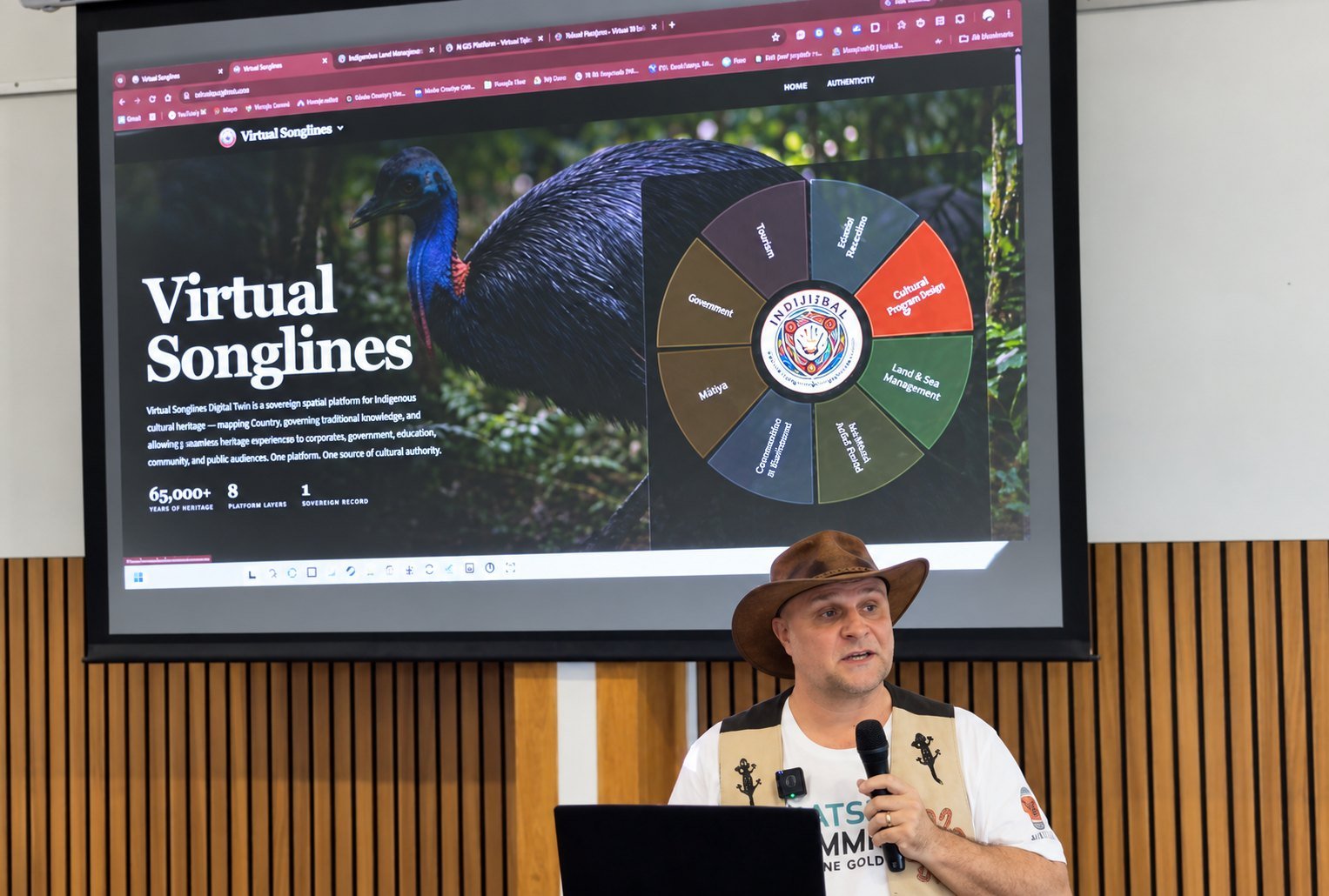
Brett Leavy presents Virtual Songlines at Mitchelton Library, Sunday 4 October 2026. Photograph: Philippe Foubert.
Brett Leavy, a Kooma man and founder of Bilbie XR Labs, rebuilds Country in three dimensions as it stood before colonisation, so that you can walk through a landscape and see what stood there before the city.
He calls the work Virtual Songlines. On Sunday 4 October 2026 he brought it to Mitchelton, and the monthly Truth-Telling Session coordinated by Rosalie Raciti and Linda Harnett, held at the Library there. He spoke for more than an hour and a half on knowledge, technology, and who should own both.
You may already know his work. At dawn on 26 January 2024, four faces rose on the sails of the Sydney Opera House: Nanbarry, Barangaroo, Pemulwuy, and Patyegarang, First Nations people of Sydney’s first colonial years. Brett made those portraits, titled Trailblazers, with the Metropolitan Local Aboriginal Land Council. Linda Harnett opened her introduction with that dawn.
A Time Machine for Country
Brett began by turning the praise away from himself. He pointed to Uncle Michael Williams in the audience, who has watched him at this work since 1982, and named Uncle Michael’s integrity about Country as the force that drives him. Then he told the room what deserves celebration.
“I’m telling other people’s stories. I’m a conduit for others. So don’t celebrate this work. Celebrate the content that’s in it, the connection to Country.”
Brett Leavy
Brett wants to build a time machine. When the Trailblazers portraits went up, he asked the people behind the commission to own its success and to blame him for anything that failed. By the end of the day the coverage centred on the four people on the sails, and Brett counted that as success. His reason: “If you don’t know where you’ve been, you don’t know where you’re going.”
Every Town Began as a Camp
A guest asked whether mapping places such as Barrambin, today’s Victoria Park, troubled him. Brett answered with a bucket of water. A litre weighs a kilogram, and nobody carts water to camp by choice. People camped beside fresh water, often where it turns brackish, on ground a metre or two above the flood line. The colonists chose the same ground for the same reasons.
“Every city and every regional town was a very, very popular camping space for First Nations people, first and foremost.”
Brett Leavy
Along Kedron Brook, he said, the camps stood on the rises above today’s bike paths. Bricks, bitumen, and footpaths now cover most of them. A voice from the floor put it plainly: every town in Australia stands where First Nations people lived, on high ground close to water.
Brett also makes the maps for historian Dr Ray Kerkhove, who spoke at Mitchelton in March 2025 on Brisbane’s Aboriginal campsites. Ray writes the books and argues the evidence. Brett turns that evidence into maps you can see.
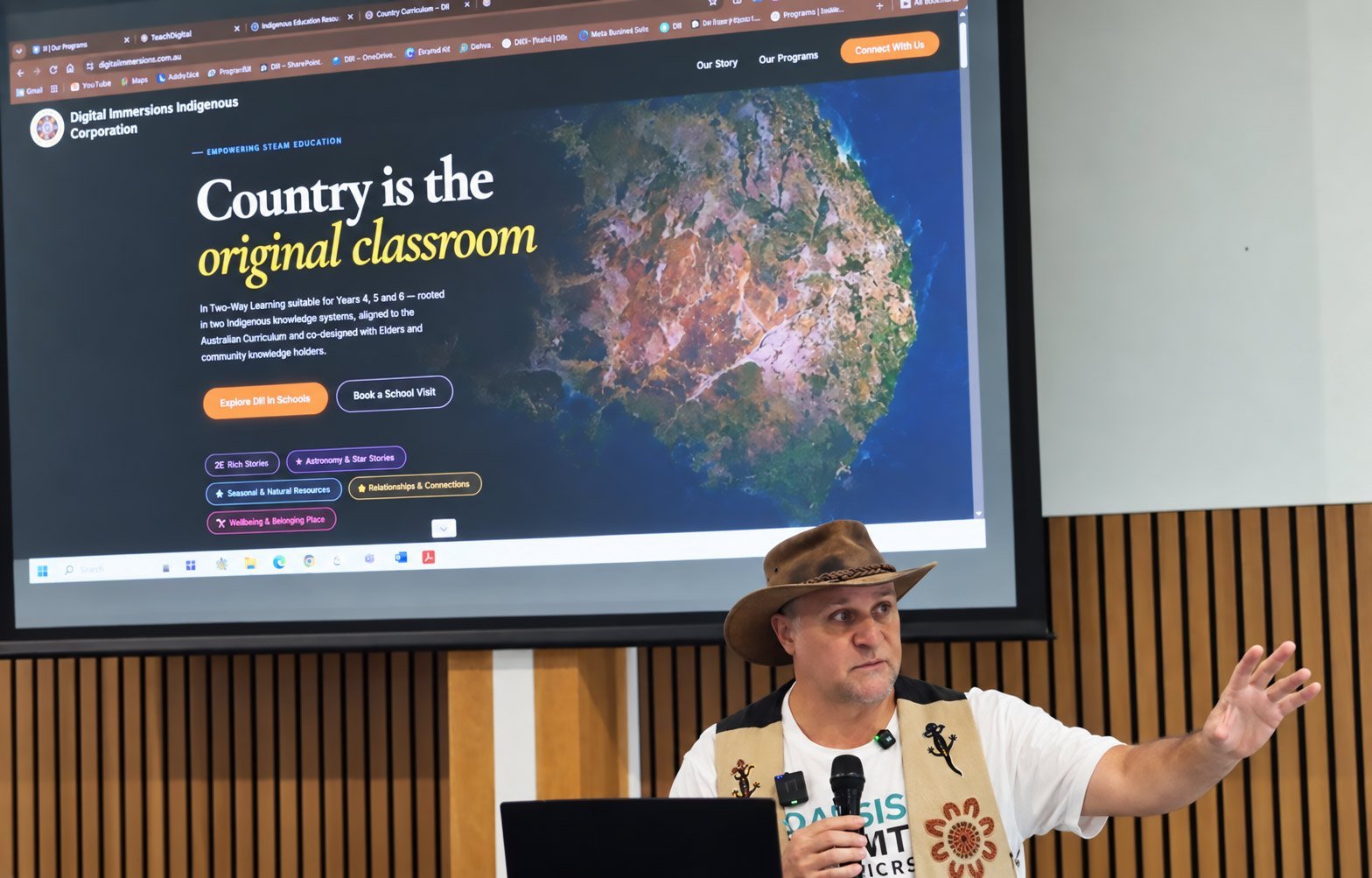
Brett Leavy shows the room a Country-based STEAM program for primary schools, Mitchelton Library, Sunday 4 October 2026. Photograph: Philippe Foubert.
Technology Owned by Community
Brett treats artificial intelligence the way he treats a car or a fridge: as a tool that communities must control. He distrusts the closed models that large companies rent back to the public, and he doubts that the money now pouring into the field will reach communities. For his own people he wants security, a life in which a broken washing machine no longer means a crisis.
He has a plan to match. Through a PhD by creative practice at QUT, which he chose over an honorary doctorate, he aims to design and fabricate a computer chip for what he calls ‘a cultural heritage intelligence protocol system’: a targeted tool for First Nations knowledge, built for First Nations people, with the data kept in Australia, ideally in First Nations data centres on native title land.
“I want a tool precisely for us, not for everybody.”
Brett Leavy
He has built national institutions before. He lobbied for the Indigenous broadcasting service that became NITV, with Senator Cheryl Kernot’s support in Canberra, and helped found national Indigenous radio and news services. All three still broadcast.
Mapping a State, Teaching a Language
For the New South Wales Government, Brett’s team has mapped cultural heritage across the whole state: about 1.7 million points of knowledge. By his count, a reader would need 107 years without sleep to get through them, so each community starts with its own region.
His team also builds websites for Local Aboriginal Land Councils around what their members need. The demand on those councils is heavy. Sydney’s Metropolitan council alone fields about 120 requests a month for Welcomes to Country, smoking ceremonies, and cultural awareness sessions.
Language comes next. The council wants an app that teaches the way a child learns to speak, through sound and the movement of breath. Brett has no patience for the usual word lists: “That’s not teaching language. That’s just a list.”
Who May See What
The sharpest question of the afternoon came from the floor. Aboriginal knowledge has layers, the questioner said, and some of it belongs only to particular people. How can a digital system respect that?
Brett’s team had argued over that very question for two days. He read from a message sent at 12.30 that afternoon: a permissions system that grants access by gender, age, and the significance of the knowledge, with Elders and custodians deciding significance. He called it one question in a thousand and gave the rule he applies to all of them.
“Document it so we can debate it, and then share it, and then improve it.”
Brett Leavy
He named the approach academic rigour with a cultural lens. Asked how the system would return knowledge to Aboriginal people learning their own culture, he drew a lesson from native title: when your neighbours fix their border, your own border grows stronger.
Brett Leavy answers the room at Mitchelton Library, Sunday 4 October 2026. Photograph: Philippe Foubert.
What Else the Room Asked
Schools. Brett runs STEM programs in schools. On Noongar Country in Western Australia he built two one-term programs for upper primary students and paid for them himself. His virtual reality work on the first colonists’ arrival in Perth has taught students at the WA Museum, with Curtin University, for four years.
So many projects. Asked how he will finish so much, Brett gave the old answer: you eat an elephant one mouthful at a time. He has already begun planning who will carry his work forward.
Victoria Park. Another guest asked whether he could rebuild Barrambin as it stood when floods turned its hills into islands. He has built three versions; one runs as a multiplayer game at the Cross River Rail Experience Centre. He then played footage of a Woolloongabba dance ground, where each group’s body paint marks the Country it came from.
Kedron Brook. A member of the Teralba Park Stolen Generations Support Group asked whether Brett would help map the stories of Kedron Brook. He said yes.
A Walk from Brisbane to Perth in 1788
Brett’s largest ambition is a photorealistic Country you can enter from a browser or a television, with nothing to download. “Pick 1788,” he said, “and walk west.” Every step would teach, and he likened the journey to a doctorate earned from a thousand teachers. Many of the best hold no degree.
“There’s a whole wealth of First Nations women who’ve got such a wealth of knowledge that don’t have a degree, that you’ve got to respect.”
Brett Leavy
He named Aunty Ethel Munn and his great-aunt Hazel McKellar, whose history Matya-Mundu, he said, argued for native title before the law knew the term.
He closed by honouring his aunt, seated in the room, who raised him and gave him the confidence to attempt anything. Colonisation left generational trauma in his family, he said, and you can flee from it or fight it. Brett fights with stories.
Vote of Thanks
Philippe Foubert gave the ‘vote of thanks.’ Speaking as a historian, he placed Brett’s work within a context the room knows well:
“Stories about history are in competition, in a society that has not known its true history. We’re in a political struggle over the narrative of history.”
He asked a question and answered it in the same breath:
“Yet what better source could there be for genuine history than First Nations historical consciousness and traditional knowledges passed down through so many generations?”
“Beyond his technical expertise and achievement, Brett demonstrates a determined intention to re-experience, through digital enhancement, the original experiences of Culture and Country.”
Philippe called Brett’s commitment to his ‘cultural intelligence protocol system’ a high ethical aspiration for deploying a technology that “otherwise looks to be monopolised by the bro-billionaires.”
Brett had mentioned six years until his retirement, so Philippe suggested Brett put AI to work designing an efficient workflow for those years, “because the tradition of handing on your knowledge is going to be very important too.”
“Thank you for making it possible for us to participate in your vision.”
Watch Brett’s reconstruction of the Brisbane River before the city, then follow four threads from his talk.
Seeing Country Beneath the CityA sentence or two on what you took away from Brett’s session, and whom you would like to hear next.
Tell Us What You Took AwayQuotations come from Philippe Foubert’s recording of the session.
All Session Reports and Learning Companions